


Lamborghini Countach: The Absolute Icon That Redefined the Supercar
There are cars that transcend decades without aging a day. The Lamborghini Countach is one of them. More than just a car, it's an aesthetic manifesto, a provocation on wheels, a vision of the future etched in aluminum and plexiglass. Produced from 1974 to 1990, the Countach graced the walls of millions of teenagers' bedrooms, shaping entire generations of enthusiasts. Even today, it evokes the same undiminished emotion. Why? Because some works of art are timeless.
The Birth of a Myth: From Bertone to Sant'Agata Bolognese
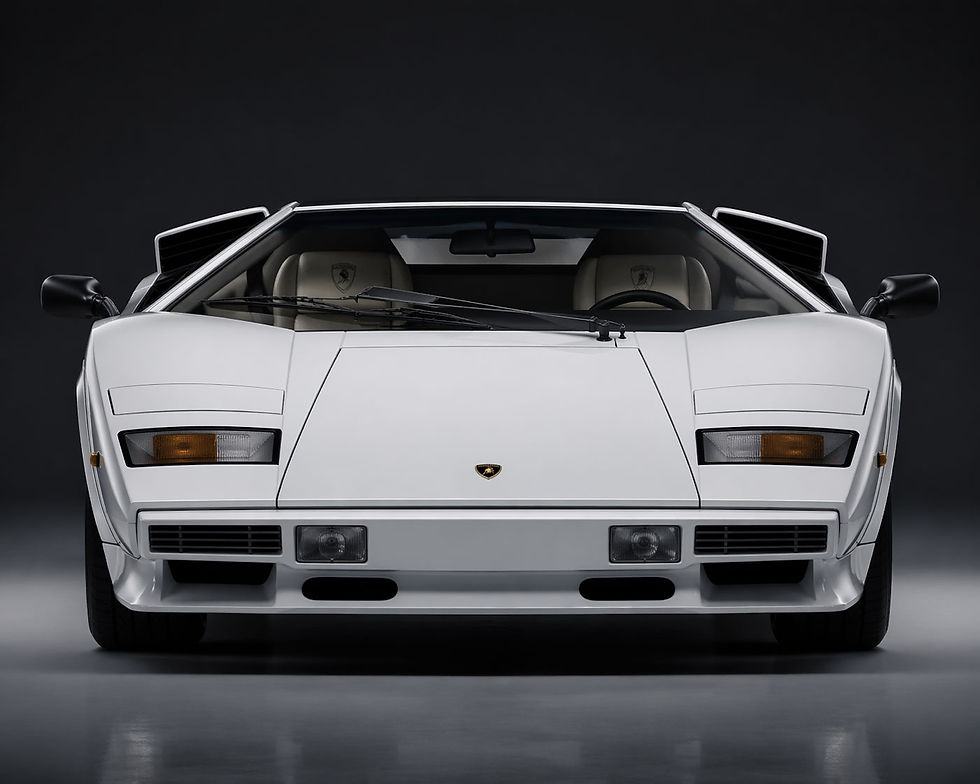
The Lamborghini Countach was born from a stroke of genius by Marcello Gandini for the coachbuilder Bertone. First presented at the Geneva Motor Show in 1971 as the LP500 prototype, the car sent shockwaves through the automotive industry. Its wedge-shaped styling, sharp lines, and low roofline were unprecedented. The word 'countach' is a Piedmontese exclamation that could be translated as 'good heavens!' – exactly the reaction it elicits from anyone who sees it for the first time.

The production version, the LP400, arrived in 1974 after three years of development. Lamborghini had to rework certain elements to meet safety and homologation standards, but the essential elements were preserved: that impossible silhouette, those scissor doors that open upwards and forwards, that jet fighter profile perched on four wheels. The 3.9-liter V12 engine, producing 375 horsepower, was positioned longitudinally inverted – the engine facing rearward – a daring technical solution inherited from the Miura.
The Design That Changed Everything: Analysis of an Aesthetic Revolution
To discuss the Countach's design is to discuss a complete break with the aesthetic conventions of its time. While the 1970s still saw cars with rounded, organic shapes inherited from the 1960s, the Countach imposed a radical geometry made up of clean lines, sharp edges, and acute angles. It anticipated by fifteen years what automotive design would become in the 1990s.
The aluminum body is mounted on a tubular steel chassis – a space-plane structure that allows for maximum rigidity at minimum weight. The drag coefficient isn't the Countach's strong point (early versions suffer from aerodynamic instability at high speeds), but this doesn't dampen Lamborghini's ambitions. The introduction of a rear spoiler on later versions largely solves the problem, although this feature divides purists who prefer the purity of the original lines.
The scissor doors, known as 'butterfly doors' or 'Lamborghini scissor doors', have become the symbol of the brand. They are dictated by the car's dimensions: the Countach is so wide and low that conventional doors would be impossible to open in most parking garages. This technical constraint becomes a major aesthetic asset, an instantly recognizable visual signature.
Performance and Mechanics: The Roaring V12
Beneath the Countach's skin beats a 60-degree V12 engine whose design dates back to the Miura. This engine, developed by Giotto Bizzarrini (the engineer who had previously worked on the Ferrari 250 GTO), is a marvel of Italian engineering. Its sound is unique: a deep rumble at low revs that rises to a strident, mechanical melody at high revs, something between a fighter jet and a quartet of soprano saxophones.
The original LP400 produced 375 hp for a weight of 1,065 kg – an exceptional power-to-weight ratio for its time. The claimed top speed was 309 km/h, although independent tests yielded slightly lower figures. But it hardly mattered: in an era when most sports cars struggled to exceed 200 km/h, the Countach was in a league of its own. It could accelerate from 0 to 100 km/h in 5.4 seconds – a performance that remains impressive even today.
The 5-speed gearbox is positioned between the engine and the front axle to optimize weight distribution. Driving the Countach is no easy feat: the steering is heavy, rear visibility is virtually nonexistent (the driver must rely on an additional external mirror), and the reclining driving position requires some getting used to. But this demanding aspect is part of the legend.
Versions: A Continuous Evolution Over 16 Years
LP400 (1974-1978): The Pure Origin
The first production series, the LP400, is the one revered by purists. No aerodynamic add-ons, just a clean, uncluttered body with pure lines. The LP stands for 'Longitudinale Posteriore' – a reference to the engine's position and orientation. Only 157 examples were produced, making the LP400 the rarest and most sought-after Countach among collectors.
LP400S (1978-1982): The Arch of Triumph
The LP400S introduced wide fender flares to accommodate wider Pirelli P7 tires. An optional rear spoiler was also introduced. The engine was increased to 4 liters, producing 350 hp – a slight decrease in power, but improvements in torque and smoothness. 235 units were produced.
LP500S (1982-1985): The Power Monster
The engine was enlarged to 4.7 liters, producing 375 hp. The LP500S benefited from significant mechanical improvements and a better interior finish. This version is the one that appears on the most teenagers' bedroom posters: its massive look with the large rear wing forged the Countach's popular image.
Quattrovalvole (1985-1988): The Most Powerful
The engine was enlarged to 5.2 liters with four valves per cylinder – hence the name 'Quattrovalvole'. Power increased to 455 hp, allowing it to reach nearly 300 km/h. This version is considered by many to be the best balance of power and refinement in the Countach range.
25th Anniversary (1988-1990): The Final Salute
Produced in a limited run of 657 units, the 25th Anniversary edition celebrates Lamborghini's 25 years. It was restyled by Horacio Pagani (yes, that Pagani) with new air intakes and updated details. This was the last Countach, replaced in 1990 by the Diablo. Collectors now compete fiercely for these examples, with prices regularly exceeding one million euros.

The Countach as a Cultural Symbol
The Lamborghini Countach transcends the realm of automobiles to become a major cultural phenomenon. Its presence in films like The Cannonball Run and music videos of the era makes it a symbol of the 1980s as iconic as the Rubik's Cube or tucked-in shoulders. It embodies a time when design didn't yet have to justify itself by aerodynamic efficiency or emissions reduction.
Today, a Lamborghini Countach LP400 in good condition can fetch between 2 and 3 million euros at auction. The Quattrovalvole and 25th Anniversary versions sell for between 400,000 and 800,000 euros. This exponential increase in value makes it one of the best automotive investments of the last twenty years.
The Space That Deserves This Legend: High-End Garage Design
A Lamborghini Countach doesn't deserve to end its days in an ordinary garage. At Innova Signature, we design exceptional spaces worthy of exceptional cars. Epoxy resin flooring, a color-selectable LED lighting system, brushed and lacquered aluminum storage units, and a display lift to give your Countach the perspective it deserves: that's what we create.
The garage becomes a gallery. Your car becomes a work of art. And the space that houses it must reflect the same exacting standards that Lamborghini has applied to every millimeter of this legendary body. This is our philosophy at Innova Signature: to transform a functional space into a sensory and cultural experience.


